Speca › Topics › GCSE Maths
Right-angled trigonometry (SOHCAHTOA)
AQA GCSE Maths
10 ready-made resources for teaching Right-angled trigonometry (SOHCAHTOA), written for AQA GCSE Maths. Slides, worksheets, mark schemes, homework, an assessment and retrieval quizzes, with SEN-friendly lesson design as standard. Below is what the topic requires and where students usually go wrong, free to read whether or not you sign up.
Get these 10 files free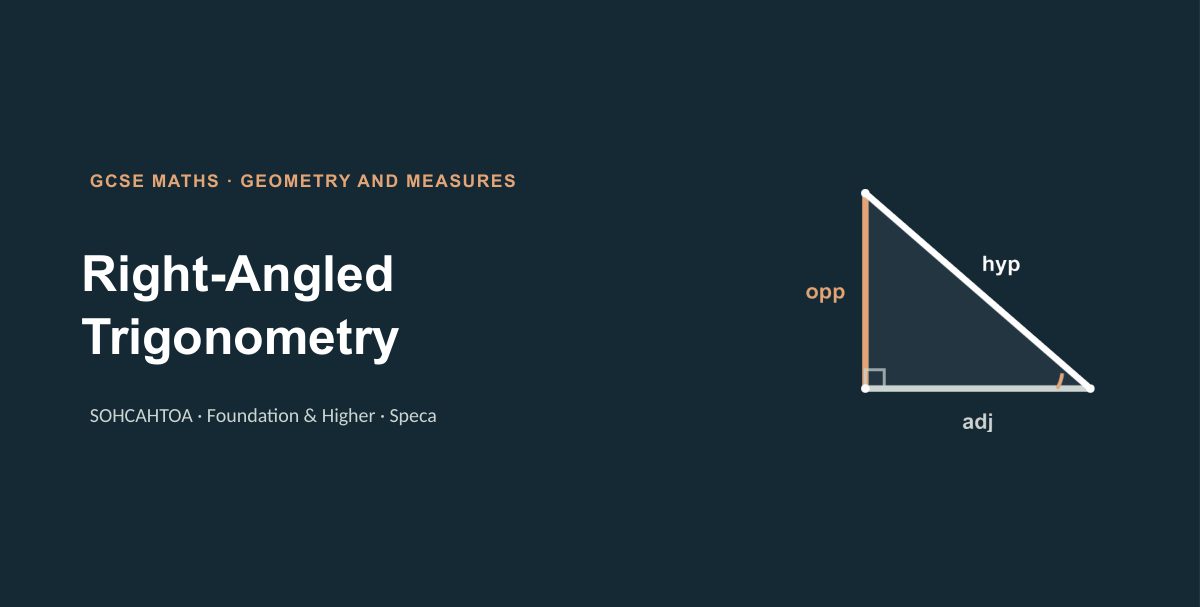
What is in this bundle
- Assessment mark schemeWord, editable
- End-of-topic assessmentWord, editable
- HomeworkWord, editable
- Retrieval gameHTML, editable
- Retrieval game answer sheetWord, editable
- Retrieval-practice quizzesWord, editable
- SlidesPowerPoint, editable
- Starter & exit ticketWord, editable
- Tiered worksheetWord, editable
- Worksheet mark schemeWord, editable
Stuck? Worked examples, step by step
The same methods the lessons teach, one step at a time. Cover the working, try it yourself, then check each step.
- Labelling a triangle
- Using sine
- Using tangent
- Angle of elevation
- a missing side, non-right-angled
- a missing side, two sides + included angle
- Area without a height
- The ladder problem, two ways
Step 1 · Labelling The Sides
Labelling a triangle
In triangle ABC, the right angle is at B. The marked angle is at A. Label sides AB, BC, and AC.
AC is opposite the right angle
AC = hypotenuse
BC is directly across from angle A
BC = opposite
AB is next to angle A (not the hypotenuse)
AB = adjacent
Always mark the angle FIRST: opposite and adjacent depend entirely on where it is.
Step 2 · Finding A Missing Side
Using sine
In a right-angled triangle, one angle is 30° and the hypotenuse is 12 cm. Find the side opposite the angle.
SOH: sin θ = Opposite ÷ Hypotenuse
sin 30° = O ÷ 12
Rearrange to make O the subject
O = 12 × sin 30°
Calculate
O = 6 cm
Calculator check: make sure it's in DEGREE mode before you start.
Known: angle = 30°, hypotenuse = 12 cm → Want: O (the opposite side)
Step 3 · Finding A Missing Angle
Using tangent
In a right-angled triangle, the opposite side is 8 cm and the adjacent side is 8 cm. Find the angle.
TOA: tan θ = Opposite ÷ Adjacent
tan θ = 8 ÷ 8 = 1
Use the INVERSE tangent function
θ = tan⁻¹(1)
Calculate
θ = 45°
Don't forget the inverse function: it undoes sin, cos or tan to get the angle back.
Known: opposite = 8 cm, adjacent = 8 cm → Want: θ (the angle)
CALCULATOR CHECK: confirm it's in DEGREE mode before you calculate.
Step 4 · Contextual Problems
Angle of elevation
A person stands 15 m from the base of a tower. The angle of elevation to the top is 40°. Find the height of the tower.
The height is opposite the angle; 15 m is adjacent
tan 40° = h ÷ 15
Rearrange to make h the subject
h = 15 × tan 40°
Calculate
h = 12.6 m
The angle of elevation is measured UP from the horizontal ground.
Known: adjacent (ground) = 15 m, angle of elevation = 40° → Want: h (the height)
CALCULATOR CHECK: confirm it's in DEGREE mode before you calculate.
Higher
a missing side, non-right-angled
In triangle ABC, angle A = 35°, angle C = 80°, and side a (opposite A) = 9 cm. Find side c (opposite C).
The sine rule connects each side to its opposite angle
a/sinA = c/sinC
Substitute and rearrange for c
c = 9 × sin 80° ÷ sin 35°
Calculate
c = 15.5 cm
Use the sine rule whenever you know an angle and its opposite side, plus one more piece.
Known: ∠A = 35°, ∠C = 80°, side a = 9 cm → Want: side c
CALCULATOR CHECK: confirm it's in DEGREE mode before you calculate.
Higher
a missing side, two sides + included angle
In triangle ABC, side b = 5 cm, side c = 8 cm, and the included angle A = 60°. Find side a.
Use the cosine rule for two sides + the angle between them
a² = b² + c² − 2bc cosA
Substitute the known values
a² = 5² + 8² − 2×5×8×cos60°
Calculate
a = 7.0 cm
SOHCAHTOA only works for RIGHT-ANGLED triangles: this triangle has none.
Known: side b = 5 cm, side c = 8 cm, ∠A = 60° → Want: side a
CALCULATOR CHECK: confirm it's in DEGREE mode before you calculate.
Higher
Area without a height
A triangle has two sides of 6 cm and 9 cm, with an included angle of 40°. Find its area.
Area formula using two sides and the included angle
Area = ½ ab sinC
Substitute the known values
Area = ½ × 6 × 9 × sin 40°
Calculate
Area = 17.4 cm²
This works even when you don't know the triangle's height.
Known: two sides = 6 cm and 9 cm, included ∠ = 40° → Want: the area
CALCULATOR CHECK: confirm it's in DEGREE mode before you calculate.
Higher
The ladder problem, two ways
A ladder reaches 8 m up a wall, with its foot 6 m from the wall. Find (a) the ladder's length, and (b) the angle it makes with the ground.
(a) Use Pythagoras' theorem for the length
L² = 8² + 6² = 100
Square root
L = 10 m
(b) Now use trigonometry for the angle
sinθ = 8 ÷ 10
Use the inverse sine function
θ = 53.1°
Spot which tool each part needs: lengths only: Pythagoras; angles: trigonometry.
CALCULATOR CHECK: confirm it's in DEGREE mode before you calculate.
Foundation tier
- Label the sides of a right-angled triangle (opposite, adjacent, hypotenuse) relative to a given angle.
- Use the sine, cosine, and tangent ratios to find a missing side length.
- Use the sine, cosine, and tangent ratios to find a missing angle.
- Solve simple contextual problems (angles of elevation/depression).
- Recall and use exact trigonometric values for standard angles (0°, 30°, 45°, 60°, 90°) without a calculator.
Higher tier, in addition
- Use the sine rule and cosine rule to solve problems involving non-right-angled triangles.
- Calculate the area of a triangle using ½ab sin(C).
- Solve multi-step problems combining trigonometry with Pythagoras' theorem or with bearings.
Where students go wrong
- Mislabelling opposite and adjacent sides: these are defined relative to the marked angle, not fixed by the triangle's physical orientation.
- Selecting the wrong ratio (sine, cosine, or tangent) for the sides given in the question.
- Calculator left in the wrong angle mode (degrees vs radians), producing plausible-looking but incorrect answers.
- Forgetting to use the inverse trig function when solving for an angle rather than a side.
- In non-right-angled triangle problems (Higher), defaulting to SOHCAHTOA instead of recognising that the sine or cosine rule is needed.
How it gets asked in the exam
"Calculate the size of angle x", "Find the length of side y", "The angle of elevation is...", "Work out the area of the triangle".
Key vocabulary
Opposite, adjacent, hypotenuse, sine, cosine, tangent, angle of elevation, angle of depression, sine rule, cosine rule (Higher), included angle.
Assumed prior knowledge
- Pythagoras' theorem.
- Rearranging equations.
- Calculator fluency with trigonometric and inverse trigonometric functions.
- Basic angle facts.
How Speca scaffolds this topic
- A consistent triangle-labelling routine, mark the angle first, then opposite/adjacent/hypotenuse in the same three colours every time, is one of the highest-leverage scaffolds for this topic.
- Provide a simple decision aid ("which two sides or angle do I already know, and which do I want to find?") as a chunked first step before any calculation.
- Include an explicit calculator-mode check as a standing step in every worked example, since incorrect mode is a common and entirely preventable error.
Every file, free to start
Three full bundles a month at no cost, no card needed. Speca can also write a resource for a topic we have not built yet, and mark your students' answers to this lesson's questions against its own mark scheme.
Start free