Speca › Resources › Back to school
Back to school, without the gap
A calm, free guide for families whose child is going back to school after home education or a long time away, including time away because of anxiety or other mental health reasons. Settle in first, find the gaps calmly and catch up a little at a time. No sign-up and no email on this page.
Going back is a big step, for your child and for you. You do not need to teach the missing months or years yourself. Your job is to organise, to encourage and to ask the school the right questions. Some councils report that more children are going back into school after home education, so you are not the only family doing this.
The first two weeks: settle in before you catch up
Catching up can wait. For the first two weeks, the job is a calm routine and a child who feels safe at school. Marks and topics come after that. A child who is settled learns more, and faster, than one who is worried.
What tends to help
- Practise the morning and evening routine a few days before the first day.
- Do the journey once beforehand, if you can, so the route is not new on the day.
- Pack the bag together the night before.
- Ask one open question after school, such as "what was the best bit?", then leave a gap. Many children talk later, at bedtime or in the car.
- Keep after-school time light. One calm thing a day is plenty.
- Notice one small win each day, and say it out loud.
What is normal to feel
- Tired and hungry. A full school day is long if you are not used to it.
- Unsure about friendships, or about who to sit with.
- Worried about being behind, or about being asked why they were away.
- Some work feels easy and some feels strange. Both are normal.
- Good days and hard days, often in the same week.
What can wait
- Catch-up work in the first two weeks.
- Comparing them with classmates, or with how they were at home.
- Lots of questions about marks and tests.
- Deciding after one bad day that it is not working.
If you are worried about how your child is coping, tell the school early. Your child's form tutor, head of year or the SENCo (the teacher in charge of special educational needs) is the right place to start.
Talk to the school
The school knows what the class is doing and what support it can offer. You know your child. The best first step is a short conversation, or an email, before the first day. Here are the questions worth asking.
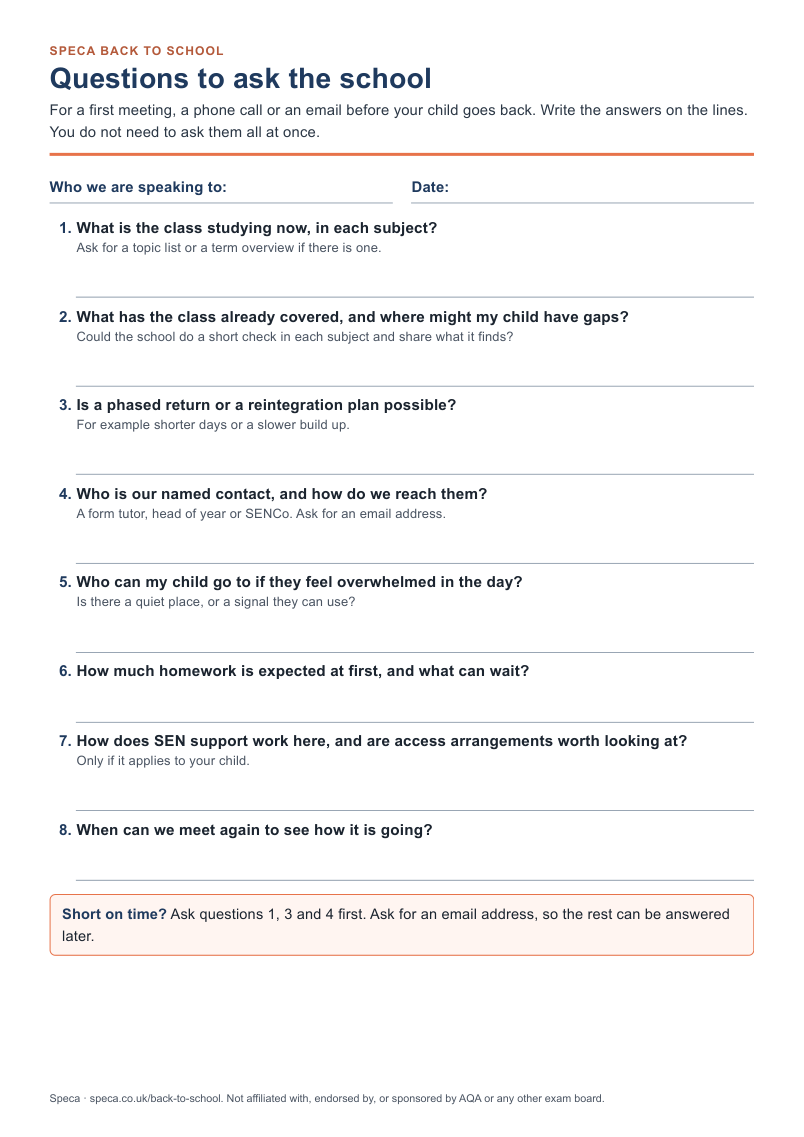
- What is the class studying now, in each subject? Ask for a topic list or a term overview if there is one.
- What has the class already covered, and where might my child have gaps? Could the school do a short check in each subject and share what it finds?
- Is a phased return or a reintegration plan possible? For example shorter days or a slower build up.
- Who is our named contact, and how do we reach them? A form tutor, head of year or SENCo. Ask for an email address.
- Who can my child go to if they feel overwhelmed in the day? Is there a quiet place, or a signal they can use?
- How much homework is expected at first, and what can wait?
- How does SEN support work here, and are access arrangements worth looking at? Only if it applies to your child.
- When can we meet again to see how it is going?
Print the questions sheet (PDF, one page)
Before you meet, write down three things you want the school to know: what helps your child, what worries them, and what has gone well. A short note is easier to hand over than to remember on the day.
If your child has special educational needs or a disability, or you think they might. Ask the school's SENCo about SEN support early. For older students, also ask about access arrangements. These are changes to how a student sits an exam, such as help with reading, writing, speed of working or concentration. They are meant to let a student show what they know, not to make the exam easier.
- The school decides, with you and your child. It looks at how the difficulty affects your child in lessons and tests, and it can take time, so ask early.
- Evidence from school matters. A report on its own does not decide it. If you are thinking of a private assessment, speak to the school first.
This is a summary in our own words of JCQ's guidance for parents, carers and students. The school's SENCo can tell you how it applies to your child.
Find the gaps, calmly
A gap is a topic the class has covered that your child has not met yet, or has not met in the same way. It is not a failure. Home education and school do not teach things in the same order, so almost every returning child has a few. The aim is a short, specific list, not a worry about "being behind".
- Get the topic list. Ask the school what the class is studying now (question 1 on the sheet).
- Try a topic, lightly. For each one, ask your child to write down everything they remember about it, with notes covered, or play a short retrieval game. No marks, no pressure.
- Tick the Gap finder. Covered, partly or not yet. Then choose three topics to start with.
Print the Gap finder (PDF, one page)
Free Speca pages, by stage
Year 6
- Year 6 Maths: every topic has a free page with worked examples and the usual mistakes.
- Retrieval games: the Year 6 Maths games have short questions on each topic, good for a light first look.
- Speca covers Maths at Year 6, not English, Science or other subjects. Ask the school what else the class is doing.
Years 7 to 9
- KS3 Maths: every Key Stage 3 Maths topic has a free page, from place value and fractions to angles, equations and probability.
- Speca does not cover Years 7 to 9 in other subjects yet, and we would rather say so. For those, ask the school for the topic list and use the same method: remember, check, fix three gaps.
Years 10 and 11 (GCSE)
- Red, amber, green revision checklists: one printable list per subject, topic by topic. A good way to fill in the Gap finder.
- Topic pages for Maths, Combined Science, Geography and English Language. Each has what students need to be able to do, the usual mistakes and how the exam asks it.
- Blurt sheets: Maths, Science and Geography. One printable sheet per topic for the "write what you remember" step.
- Practice papers for Maths and English Language, with mark schemes. Save these for later, once your child has settled. Those two pages ask for your email address.
- English Language guides to Paper 1 and Paper 2, question by question.
- Speca's GCSE pages are written to the AQA specifications. Ask the school which exam board your child is on. If they take the three separate sciences, there is extra content Speca does not cover.
Everything else
Speca does not cover other subjects, such as History, Languages or Computing, or other year groups. The method still works. Ask the school for the topic list, tick it in the Gap finder, and for each topic remember, check and fix three gaps.
Catch up a little at a time
This is a suggestion, not a rule. Once your child has settled in, short and regular is kinder than long and rare. A common pattern is 20 minutes, three times a week, on one topic at a time, with at least one day off.
Every session, the same four steps
- Warm up (2 minutes). Ask what they remember from last time.
- Blurt (5 minutes). Cover the notes and write everything they remember about the topic. Or play a short retrieval game.
- Check (5 minutes). Look at the topic page or a blurt sheet and tick what they got.
- Fix three (8 minutes). Pick three gaps and learn them properly. Then stop.
Next session, start by remembering the three from last time, then move on. Come back to a topic a few days later and again a week or two after that. Going back over things is how they stick.
Your role is organiser and encourager, not teacher. Sit near them, keep the time short, praise the effort and finish on something that went well. If a session turns into a battle, stop and try again another day.
The first four weeks
| Week | What you do |
|---|---|
| Week 1 | Settle in. Practise the routine. Say hello to the named contact. No catch-up work yet. |
| Week 2 | Settle and look. Ask for the topic list. Fill in the Gap finder together. Still no catch-up work. |
| Week 3 | Start small. Three sessions of 20 minutes, all on one topic. |
| Week 4 | Look back. Three more sessions. Update the Gap finder. Tell the school how it is going. |
If school is hard right now
Going back to school is not a test, and a hard week does not mean it has failed or that anyone has done something wrong. Many children find the first weeks tiring, and some need more than one go. Returning to school and leaving again are both common. Tell the school early when things are getting harder, and ask what they can change. If your child's anxiety is high, or you are worried about how they are, speak to the school (the form tutor, head of year or SENCo) and to your child's GP. The NHS also has a public page of advice and support about mental health for children, teenagers and young adults, which includes where to find urgent help. This page is general guidance, not medical advice.
The three printables
Each one is a single A4 page in a clear, large font. No sign-up and no email.
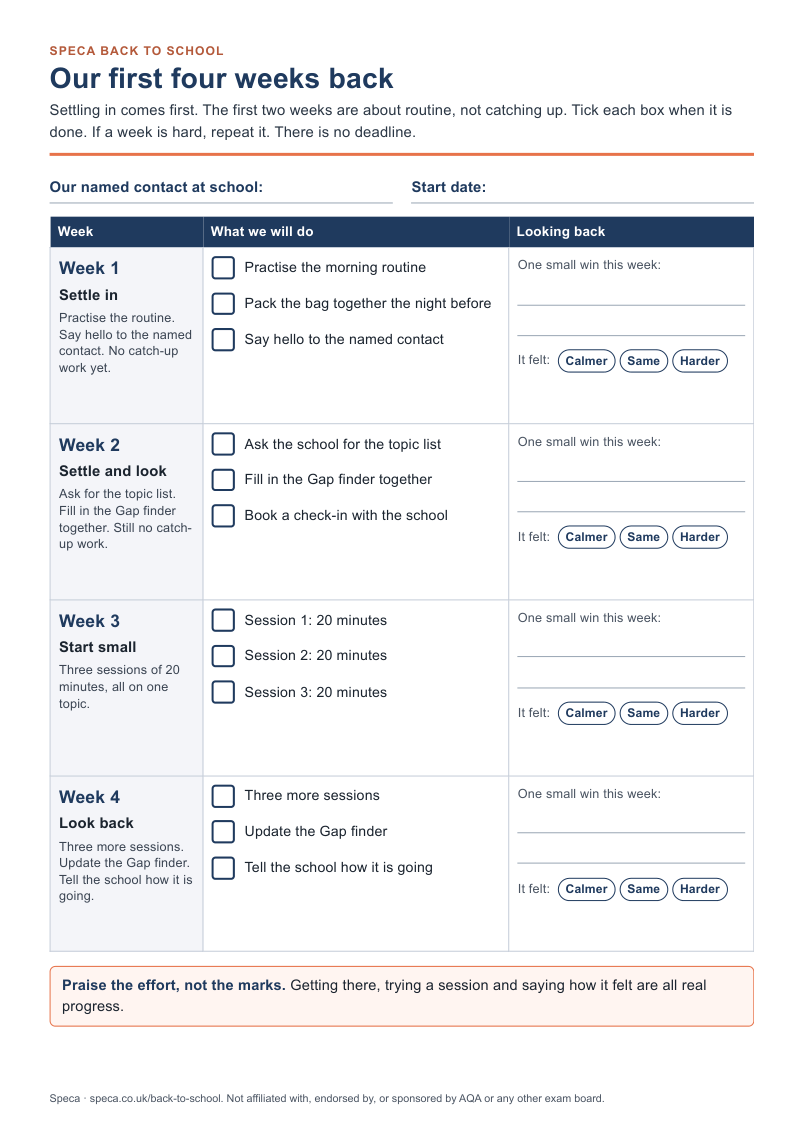
Our first four weeks back
Four weeks of tick boxes: settle in first, then start small.
Download the PDF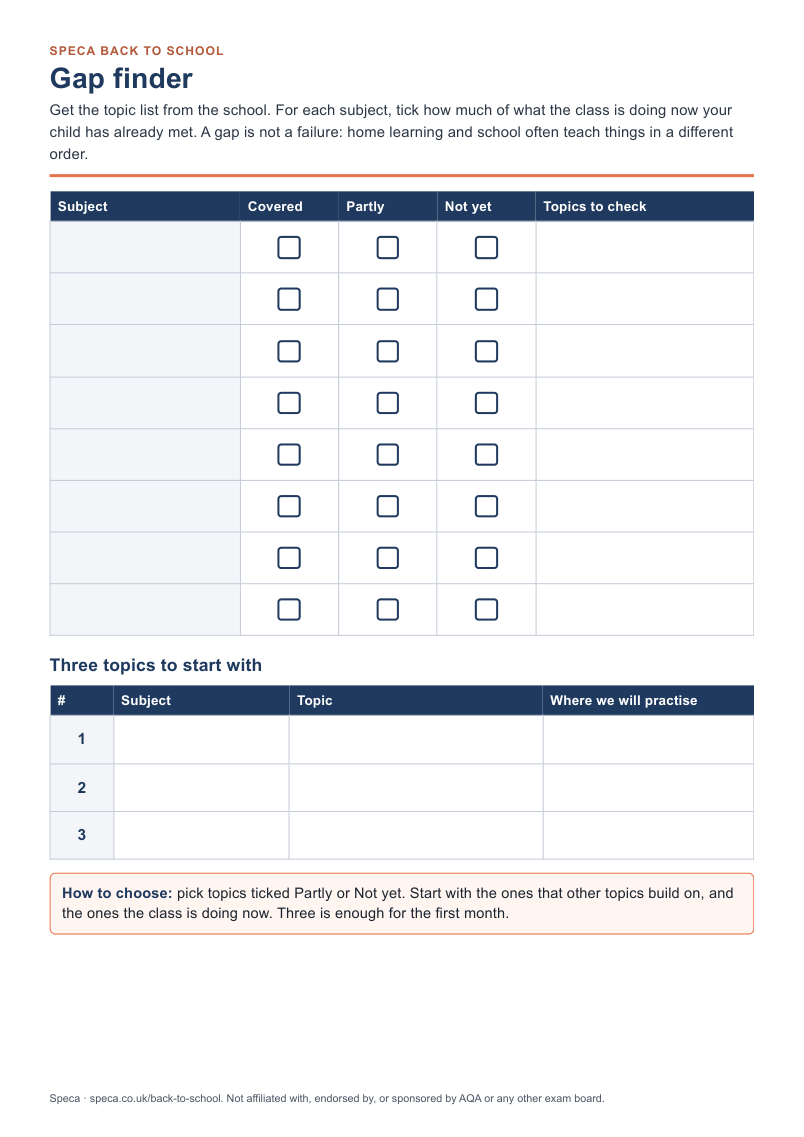
A teacher?
Speca builds ready-to-teach lesson resources with SEN-friendly lesson design as standard.
See the homepageSpeca is not affiliated with, endorsed by, or sponsored by AQA or any other exam board. The advice on this page is general and written by Speca in our own words. It is not medical advice and it is not an exam board document.