Speca › Resources › GCSE resit plan
Missed a 4? Your November resit plan.
A free plan for GCSE English Language and Maths resits: short sessions of 30 to 45 minutes, four or five days a week, each one linked to a free Speca resource. No sign-up and no email on this page.
If you were a few marks short in the summer, you do not need to relearn the whole course. You need to stop losing the marks you nearly had, and to practise under time. That fits alongside college.
November 2026 exam dates (AQA)
| English Language Paper 1 | Tuesday 3 November, morning |
| English Language Paper 2 | Thursday 5 November, morning |
| Maths Paper 1 (no calculator) | Wednesday 4 November, morning |
| Maths Paper 2 (calculator) | Friday 6 November, morning |
| Maths Paper 3 (calculator) | Monday 9 November, morning |
From AQA's published November 2026 timetable. Check the exact start time and room with your exam centre. On a different exam board? Your board has its own dates, and your centre will confirm them.
Which plan?
- The exams start on 3 November. With less than four weeks to go, use the 2-week plan. If you have a few extra days, repeat the sessions you found hardest.
- Four weeks or more (for example, if you are resitting in the summer instead): use the 4-week plan.
- Resitting both? Do one English and one Maths session on most days, or alternate days. Keep at least one day a week completely off.
- Every session starts with what to do and ends with links. Most begin with a 5-minute retrieval game on something from an earlier session: remembering it again is what makes it stick.
English Language
Where the grade 4 marks are
Writing is worth the same as reading on each paper, and it is the part you can prepare most. So both plans start with writing: a plan shape you trust, and the mistakes you personally make with spelling and punctuation.
Timings for every question
These suggested timings are ours, not the exam board's. They share the time out roughly in line with the marks.
| Question | Marks | Time |
|---|---|---|
| Paper 1: 80 marks, 1 hour 45 minutes | ||
| Reading the extract | about 15 min | |
| Question 1 | 4 | about 5 min |
| Question 2 | 8 | about 10 min |
| Question 3 | 8 | about 10 min |
| Question 4 | 20 | about 20 min |
| Question 5 (writing) | 40 | about 45 min |
| Paper 2: 80 marks, 1 hour 45 minutes | ||
| Reading both sources | about 10 min | |
| Question 1 | 4 | about 5 min |
| Question 2 | 8 | about 10 min |
| Question 3 | 12 | about 15 min |
| Question 4 | 16 | about 20 min |
| Question 5 (writing) | 40 | about 45 min |
The near-pass mistakes to fix
- Naming a technique and stopping.
- “This is a metaphor” earns very little. Say what it makes the reader picture or feel, and why that matters to the question.
- Question 1: going outside the lines you are given.
- Only facts from the lines named in the question count. Copy them short and exact.
- Paper 1 Question 3: writing about single words again.
- This question is about the order of the whole extract: how it opens, where the focus shifts, how it ends.
- Paper 1 Question 4: retelling the story.
- Say how well the writer does something, in your own view, with a quotation for every point.
- Paper 2 Question 2: one source at a time.
- Draw the two sources together. “Whereas” is your friend.
- Paper 2 Question 4: what, but not how.
- Compare what each writer thinks and the methods each uses to get it across. You need both.
- Question 5: writing about the reading extract.
- The writing task wants something new of your own, not an answer about the text you just read.
- Question 5: a story that runs away from you.
- A simple story you control beats a big plot you cannot finish. A description that turns into a list of events has drifted.
- No plan and no ending.
- Five minutes of planning, and a deliberate last line, stop the rushed ending that loses easy marks.
- No time to check.
- Keep 5 minutes to proofread. Technical accuracy is 16 of the 40 writing marks on each paper.
- Running out of time on Paper 1 Question 4.
- It is worth 20 marks. Write the finish time for each question on the paper before you start.
Your English plan
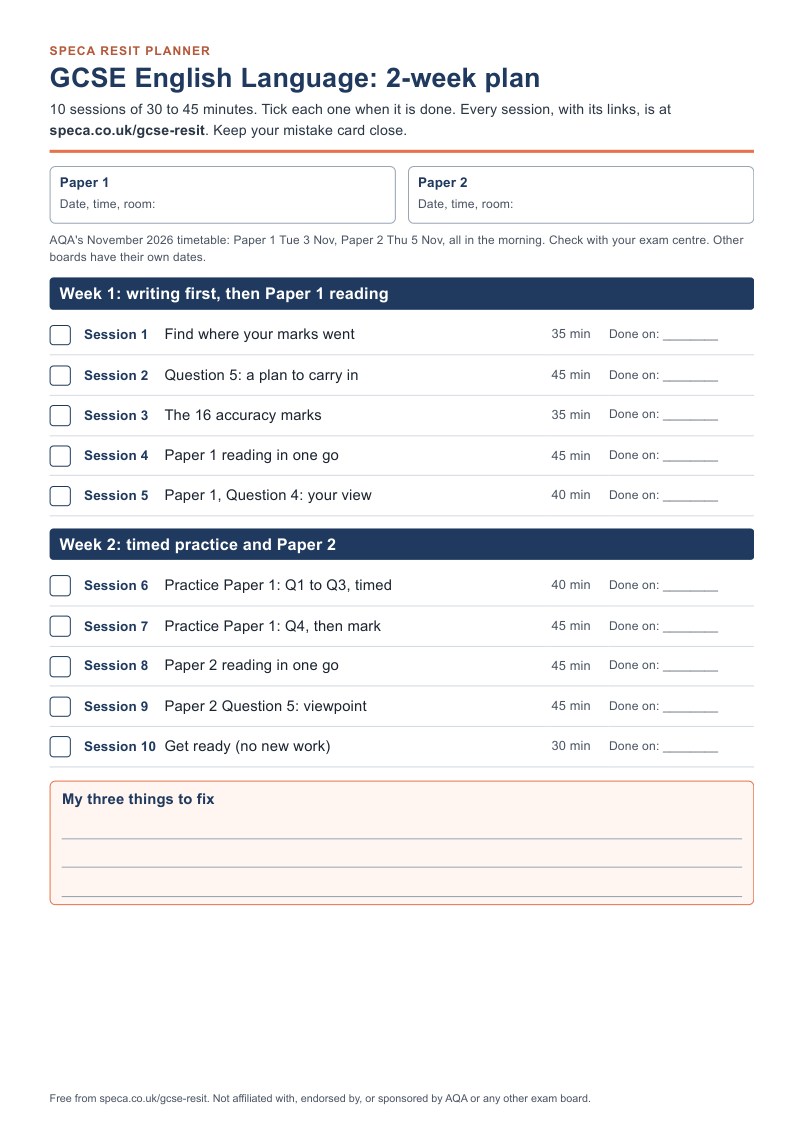
2 weeks left: the short plan (10 sessions)
Print the 2-week planner (PDF, one page)
Week 1: writing first, then Paper 1 reading
- Session 135 minutes
Find where your marks went
- Print the English Language revision checklist.
- Colour each of its five rows red, amber or green. Be honest: nobody else sees it.
- Read “Where the grade 4 marks are” on this page.
- Write down the two questions you most want to fix.
- Session 245 minutes
A Question 5 plan you can carry into the exam
- Read the Question 5 section of the Paper 1 guide.
- Print the Paper 1 planning mat.
- Plan one description and one story, five minutes each. Do not write them yet.
- Write only the opening paragraph of the one you like best.
- Session 335 minutes
The 16 marks for accuracy
- Take something you have written. Last session's opening is fine.
- Check it line by line with the accuracy checklist on the planning mat.
- Find the five mistakes you make most. Write them on a small card and keep it.
- Rewrite the opening with those five fixed.
- Session 445 minutes
Paper 1 reading in one go
- Read Questions 1, 2 and 3 in the Paper 1 guide.
- On the terms sheet, learn six terms and their effect starters.
- Write one paragraph for Question 2: technique, effect, link to the question.
- Finish with 5 minutes on the Paper 1 reading game.
Paper 1 guide: Questions 1 to 3Terms sheet and planning matsPaper 1 reading game
- Session 540 minutes
Paper 1, Question 4: your view, with evidence
- Warm up: 5 minutes on the Paper 1 reading game.
- Read Question 4 in the Paper 1 guide. It is 20 marks, half the reading marks on that paper.
- Start with your own view in one sentence, then back it up with a quotation.
- Write for 20 minutes on the guide's task, then stop, even if you are not finished.
Week 2: timed practice and Paper 2
- Session 640 minutes
Practice Paper 1: Questions 1 to 3, timed
- The practice papers ask for an adult's email, so ask a parent, carer or teacher to download them for you.
- Read the extract in 15 minutes, then answer Questions 1 to 3 in 25 minutes.
- Keep the mark scheme back for next time.
- Session 745 minutes
Practice Paper 1: Question 4, then mark it
- Answer Question 4 in 20 minutes.
- Mark Questions 1 to 4 with the mark scheme.
- For each question, write one thing that would have earned more.
- Session 845 minutes
Paper 2 reading in one go
- Read Questions 1 to 4 in the Paper 2 guide. Notice how it differs from Paper 1.
- Question 2: practise three sentences that each use “whereas”.
- Question 4: draw two columns, what each writer thinks and how they show it.
- Finish with 5 minutes on the Paper 2 reading game.
- Session 945 minutes
Paper 2 Question 5: your viewpoint
- Read Question 5 in the Paper 2 guide and print the Paper 2 planning mat.
- 5 minutes: plan. 35 minutes: write.
- 5 minutes: proofread with your mistake card.
Paper 2 guide: Question 5Terms sheet and planning matsPaper 2 writing game
- Session 1030 minutes
Get ready
- Read your mistake card and your two Question 5 plan shapes.
- Copy the timings table from this page onto a small card.
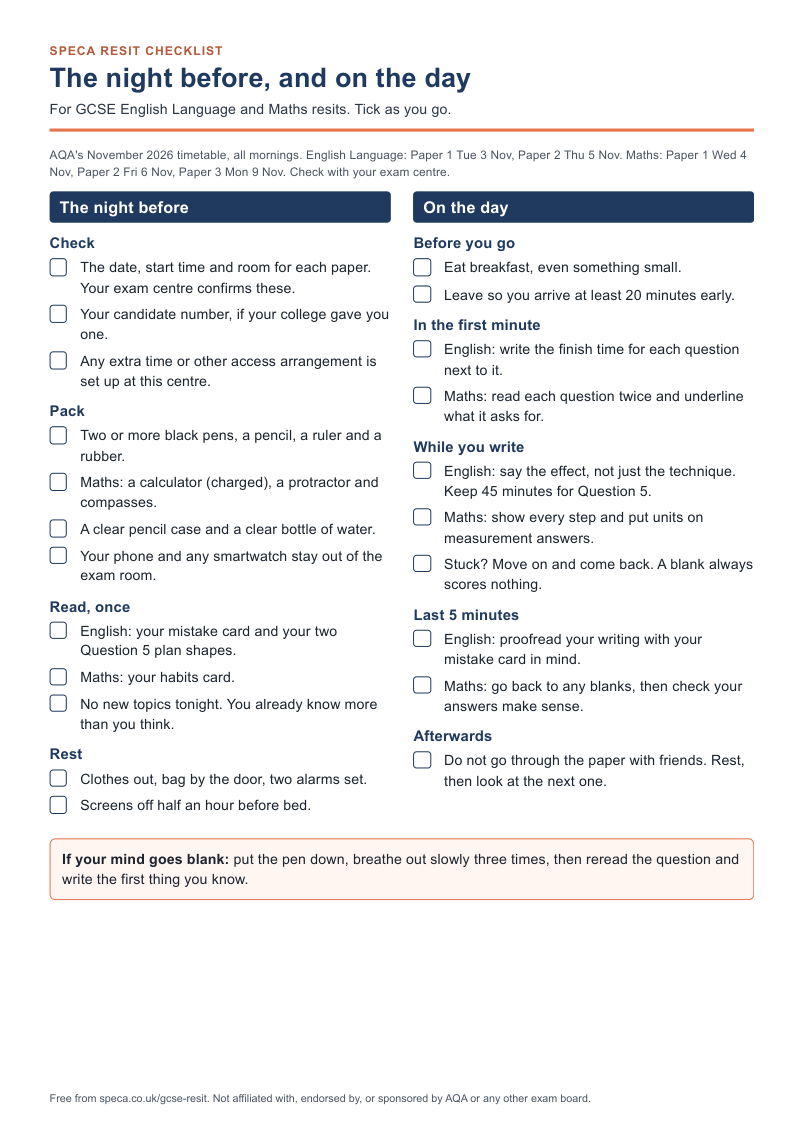
- Print the night-before checklist and pack your bag. No new topics today.
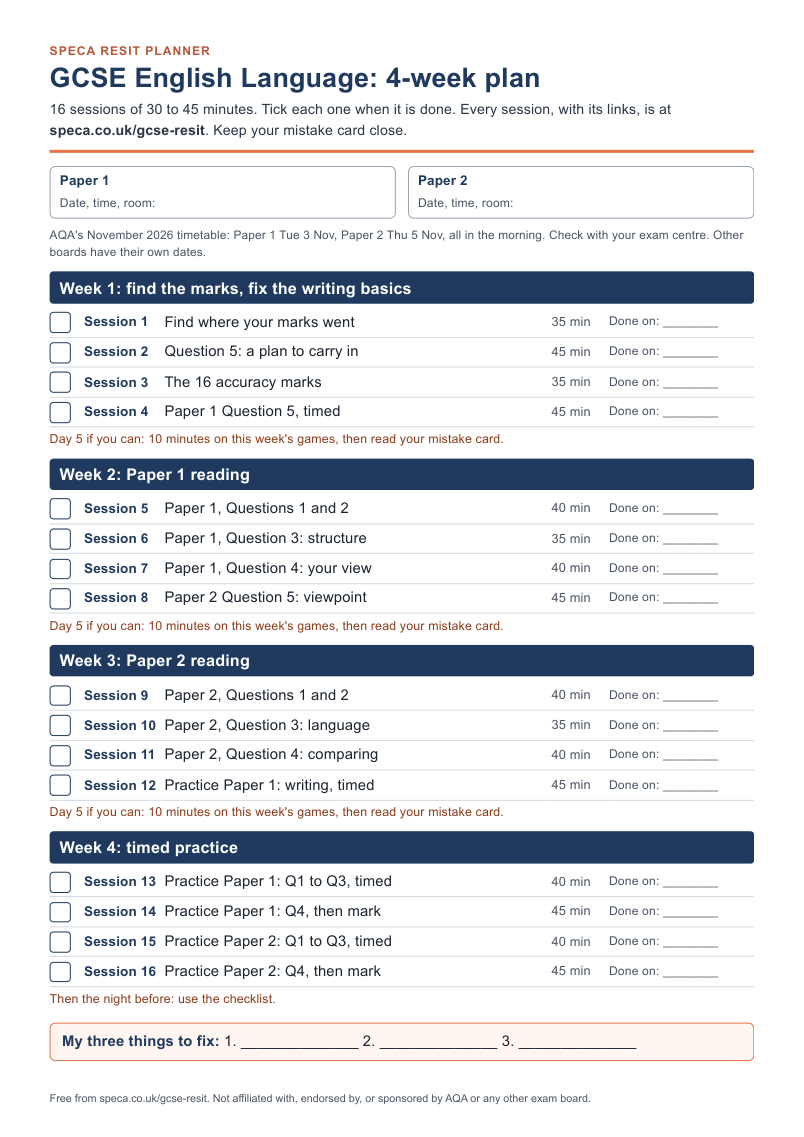
4 weeks or more: the full plan (16 sessions)
Print the 4-week planner (PDF, one page)
Week 1: find the marks, fix the writing basics
- Session 135 minutes
Find where your marks went
- Print the English Language revision checklist.
- Colour each of its five rows red, amber or green. Be honest: nobody else sees it.
- Read “Where the grade 4 marks are” on this page.
- Write down the two questions you most want to fix.
- Session 245 minutes
A Question 5 plan you can carry into the exam
- Read the Question 5 section of the Paper 1 guide.
- Print the Paper 1 planning mat.
- Plan one description and one story, five minutes each. Do not write them yet.
- Write only the opening paragraph of the one you like best.
- Session 335 minutes
The 16 marks for accuracy
- Take something you have written. Last session's opening is fine.
- Check it line by line with the accuracy checklist on the planning mat.
- Find the five mistakes you make most. Write them on a small card and keep it.
- Rewrite the opening with those five fixed.
- Session 445 minutes
Paper 1 Question 5, timed
- Pick one of the writing tasks in the Paper 1 guide.
- 5 minutes: plan on the mat. 35 minutes: write.
- 5 minutes: proofread with your mistake card.
Day 5 if you can: 10 minutes on this week's games, then read your mistake card.
Week 2: Paper 1 reading
- Session 540 minutes
Paper 1, Questions 1 and 2
- Warm up: 5 minutes on the Paper 1 reading game.
- Read Questions 1 and 2 in the Paper 1 guide, model answers included.
- On the terms sheet, learn six language terms and their effect starters.
- Write one paragraph on a quotation from the guide's extract: technique, effect, link to the question.
Paper 1 reading gamePaper 1 guide: Questions 1 and 2Terms sheet and planning mats
- Session 635 minutes
Paper 1, Question 3: structure
- Read Question 3 in the Paper 1 guide.
- On the terms sheet, learn opening, focus shift, zoom in and zoom out, and ending.
- Using the guide's extract, write two sentences on where the focus shifts and why.
- Session 740 minutes
Paper 1, Question 4: your view, with evidence
- Warm up: 5 minutes on the Paper 1 reading game.
- Read Question 4 in the Paper 1 guide. It is 20 marks, half the reading marks on that paper.
- Start with your own view in one sentence, then back it up with a quotation.
- Write for 20 minutes on the guide's task, then stop, even if you are not finished.
- Session 845 minutes
Paper 2 Question 5: your viewpoint
- Read Question 5 in the Paper 2 guide and print the Paper 2 planning mat.
- 5 minutes: plan. 35 minutes: write.
- 5 minutes: proofread with your mistake card.
Paper 2 guide: Question 5Terms sheet and planning matsPaper 2 writing game
Day 5 if you can: 10 minutes on this week's games, then read your mistake card.
Week 3: Paper 2 reading
- Session 940 minutes
Paper 2, Questions 1 and 2
- Warm up: 5 minutes on the Paper 2 reading game.
- Read Questions 1 and 2 in the Paper 2 guide.
- Question 2 needs both sources. Write three sentences that each use the word “whereas”.
- Session 1035 minutes
Paper 2, Question 3: language
- Read Question 3 in the Paper 2 guide.
- On the terms sheet, learn rhetorical question, direct address and emotive language.
- Write two paragraphs on the guide's source: technique, effect, link.
- Session 1140 minutes
Paper 2, Question 4: comparing
- Read Question 4 in the Paper 2 guide.
- Draw two columns: what each writer thinks, and how each one shows it.
- Write two paragraphs. Every paragraph must mention both writers.
- Session 1245 minutes
Practice Paper 1: the writing task, timed
- The practice papers ask for an adult's email, so ask a parent, carer or teacher to download them for you.
- Choose one of the two Question 5 tasks.
- 5 minutes: plan on the mat. 35 minutes: write. 5 minutes: proofread with your mistake card.
Day 5 if you can: 10 minutes on this week's games, then read your mistake card.
Week 4: timed practice
- Session 1340 minutes
Practice Paper 1: Questions 1 to 3, timed
- The practice papers ask for an adult's email, so ask a parent, carer or teacher to download them for you.
- Read the extract in 15 minutes, then answer Questions 1 to 3 in 25 minutes.
- Keep the mark scheme back for next time.
- Session 1445 minutes
Practice Paper 1: Question 4, then mark it
- Answer Question 4 in 20 minutes.
- Mark Questions 1 to 4 with the mark scheme.
- For each question, write one thing that would have earned more.
- Session 1540 minutes
Practice Paper 2: Questions 1 to 3, timed
- Read both sources in 10 minutes.
- Answer Questions 1 to 3 in 30 minutes.
- Session 1645 minutes
Practice Paper 2: Question 4, then mark it
- Answer Question 4 in 20 minutes.
- Mark Questions 1 to 4 with the mark scheme.
- For each question, write one thing that would have earned more.
Then the night before: use the checklist.
Maths (Foundation)
This plan is written for Foundation, the tier most Maths resitters sit. Not sure which tier you are entered for? Ask your college, and see Foundation or Higher explained.
Where the grade 4 marks are
Maths is three papers of 1 hour 30 minutes. Paper 1 has no calculator; Papers 2 and 3 allow one. Each paper mixes topics, so there is no single topic to cram. Two things matter most for a near-pass: the habits that stop you dropping marks you have earned, and the topics that other topics are built on.
Habits that protect your marks
- Show every step.
- Speca's mark schemes, like real ones, give method marks: a correct method can still score when the final answer is wrong. A wrong answer on its own scores nothing.
- Write down what you typed into the calculator.
- If you press a wrong key, the working you wrote can still earn the method marks.
- Read the question twice and underline what it asks for.
- The units, “to 1 decimal place”, “show that”, “give a reason”. Missing one of these throws away a mark you had earned.
- Put units on every measurement answer.
- And convert units before you calculate, not after.
- Do not round until the end.
- Rounding halfway through can push the final answer outside what is accepted.
- “Give a reason” means words.
- Write the fact, for example “angles on a straight line add up to 180°”.
- Never leave a blank.
- Write the first step you know. A blank always scores nothing.
- Ask: does my answer make sense?
- A probability is between 0 and 1. A price, a length or an angle should look sensible.
Topics to put first
We have not counted how often each topic comes up, and nobody can promise what will be on your paper. This order comes from how the topics connect in Speca's own lesson map: the first ones are used inside many others, so time spent on them helps right across the paper.
- Percentages and Ratio and proportion. All of this is Foundation content. In our lesson map, ratio is used inside percentages, similar shapes, pie charts, and speed and density questions.
- Solving linear equations. The rearranging you learn here comes back in inequalities, quadratics, Pythagoras, trigonometry, sequences and formulas such as speed = distance ÷ time.
- Angles and similarity. Angle facts come back in trigonometry, rotations and bearings. Each one needs its reason written in words.
- Area and volume and Pythagoras. Mostly Foundation content, with clear step-by-step methods. Steps written down are steps that can earn method marks.
- Averages and spread and Charts and graphs and Probability. Much of it is reading a table or chart carefully, then one calculation.
- Later, or only if there is time. Circle theorems at Foundation is only naming the parts of a circle: ten minutes. Skip anything on a topic page under “Higher tier, in addition”.
Small slips that cost near-pass marks
- Stopping at 3x = 12. Finish it: x = 4.
- Sharing in a ratio by dividing by the wrong number. Add the parts first.
- Forgetting the square root at the end of a Pythagoras question.
- Using the diameter when the formula needs the radius.
- Dividing by the number of rows, not the total frequency, for a mean from a table.
- Converting cm² to m² by dividing by 100. It is 10,000.
- Comparing best buys before the units match.
Your Maths plan
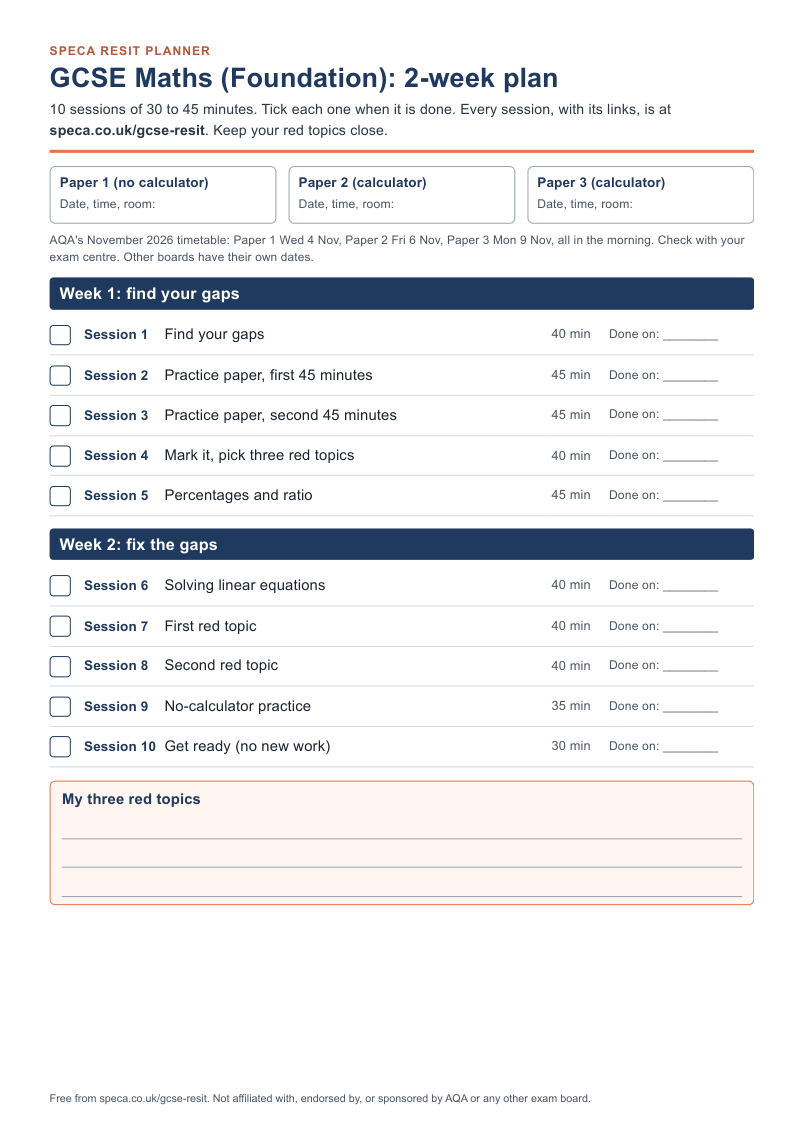
2 weeks left: the short plan (10 sessions)
Print the 2-week planner (PDF, one page)
Week 1: find your gaps
- Session 140 minutes
Find your gaps
- Print the Maths revision checklist.
- For each topic, colour the Foundation points red, amber or green.
- Read “Where the grade 4 marks are” on this page.
- Copy the habits list onto a card. You will use it every session.
- Session 245 minutes
Foundation practice paper, first half
- The practice papers ask for an adult's email, so ask a parent, carer or teacher to download them for you.
- Sit the Foundation paper for 45 minutes with a calculator. Write every step.
- Stop at 45 minutes and mark where you got to.
- Session 345 minutes
Foundation practice paper, second half
- Carry on from where you stopped, for another 45 minutes.
- Keep the mark scheme back until you have finished.
- Session 440 minutes
Mark it and pick three red topics
- Mark the paper with the mark scheme. Every answer names its topic.
- For each lost mark, write the topic and why: did not know it, a slip in the method, or misread the question.
- Circle your three weakest topics. These are your red topics for later sessions.
- Session 545 minutes
Number first: percentages and ratio
- Work through the percentages worked examples. Cover each answer and try it first.
- Do the same for ratio and proportion. Stick to the Foundation part of each page.
- Finish with 5 minutes on each game.
Percentages: worked examplesRatio and proportion: worked examplesPercentages gameRatio and proportion game
Week 2: fix the gaps
- Session 640 minutes
Solving linear equations
- Warm up: 5 minutes on the percentages game.
- Work through the solving linear equations worked examples. Cover each answer and try it first.
- Always finish: 3x = 12 is not an answer yet, x = 4 is.
- Finish on the equations game.
Percentages gameSolving linear equations: worked examplesSolving linear equations game
- Session 740 minutes
Your first red topic
- Warm up: 5 minutes on the game from your last session.
- Open your red topic's page and work through the worked examples.
- Read “Where students go wrong” on the same page. Are you doing any of them?
- Play that topic's game until you can answer without peeking.
- Session 840 minutes
Your second red topic
- Warm up: 5 minutes on the game from your last session.
- Open your red topic's page and work through the worked examples.
- Read “Where students go wrong” on the same page. Are you doing any of them?
- Play that topic's game until you can answer without peeking.
- Session 935 minutes
Paper 1 has no calculator
- Pick ten questions from your practice paper that you did with a calculator.
- Do them again by hand, writing every step.
- Check them against the mark scheme.
- Session 1030 minutes
Get ready
- Read your habits card.
- Play one game you found hard, for 10 minutes.
- Print the night-before checklist and pack your bag. No new topics today.
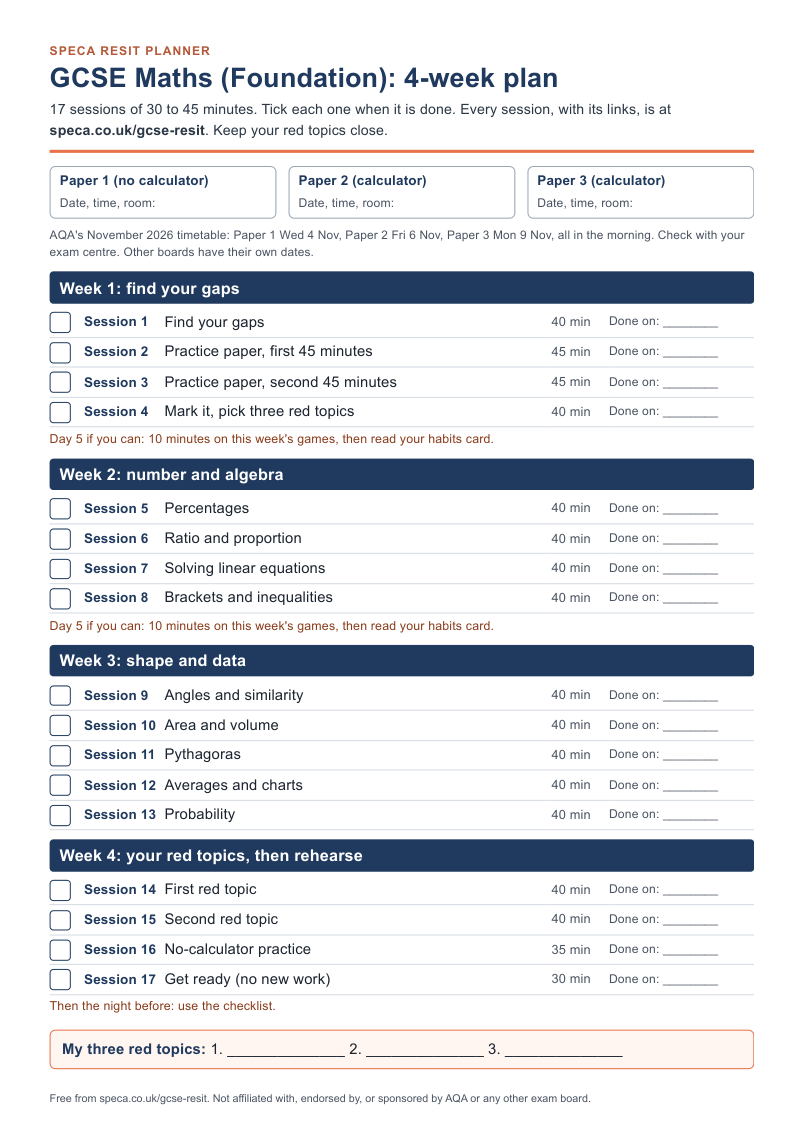
4 weeks or more: the full plan (17 sessions)
Print the 4-week planner (PDF, one page)
Week 1: find your gaps
- Session 140 minutes
Find your gaps
- Print the Maths revision checklist.
- For each topic, colour the Foundation points red, amber or green.
- Read “Where the grade 4 marks are” on this page.
- Copy the habits list onto a card. You will use it every session.
- Session 245 minutes
Foundation practice paper, first half
- The practice papers ask for an adult's email, so ask a parent, carer or teacher to download them for you.
- Sit the Foundation paper for 45 minutes with a calculator. Write every step.
- Stop at 45 minutes and mark where you got to.
- Session 345 minutes
Foundation practice paper, second half
- Carry on from where you stopped, for another 45 minutes.
- Keep the mark scheme back until you have finished.
- Session 440 minutes
Mark it and pick three red topics
- Mark the paper with the mark scheme. Every answer names its topic.
- For each lost mark, write the topic and why: did not know it, a slip in the method, or misread the question.
- Circle your three weakest topics. These are your red topics for later sessions.
Day 5 if you can: 10 minutes on this week's games, then read your habits card.
Week 2: number and algebra
- Session 540 minutes
Percentages
- Warm up: 5 minutes on the game from your last session.
- Work through the percentages worked examples. Cover each answer and try it first.
- Stick to the Foundation part of the page.
- Finish on the percentages game until you can answer without peeking.
- Session 640 minutes
Ratio and proportion
- Warm up: 5 minutes on the game from your last session.
- Work through the ratio and proportion worked examples. Cover each answer and try it first.
- Stick to the Foundation part of the page.
- Finish on the ratio and proportion game until you can answer without peeking.
Ratio and proportion: worked examplesRatio and proportion game
- Session 740 minutes
Solving linear equations
- Warm up: 5 minutes on the game from your last session.
- Work through the solving linear equations worked examples. Cover each answer and try it first.
- Stick to the Foundation part of the page.
- Finish on the solving linear equations game until you can answer without peeking.
Solving linear equations: worked examplesSolving linear equations game
- Session 840 minutes
Expanding, factorising and inequalities
- Warm up: 5 minutes on the game from your last session.
- Work through the expanding, factorising and inequalities worked examples. Cover each answer and try it first.
- Stick to the Foundation part of the page.
- Finish on the expanding, factorising and inequalities game until you can answer without peeking.
Expanding, factorising and inequalities: worked examplesExpanding, factorising and inequalities game
Day 5 if you can: 10 minutes on this week's games, then read your habits card.
Week 3: shape and data
- Session 940 minutes
Angles and similarity
- Warm up: 5 minutes on the game from your last session.
- Work through the angles and similarity worked examples. Cover each answer and try it first.
- Stick to the Foundation part of the page.
- Finish on the angles and similarity game until you can answer without peeking.
Angles and similarity: worked examplesAngles and similarity game
- Session 1040 minutes
Area and volume
- Warm up: 5 minutes on the game from your last session.
- Work through the area and volume worked examples. Cover each answer and try it first.
- Stick to the Foundation part of the page.
- Finish on the area and volume game until you can answer without peeking.
- Session 1140 minutes
Pythagoras
- Warm up: 5 minutes on the game from your last session.
- Work through the pythagoras worked examples. Cover each answer and try it first.
- Stick to the Foundation part of the page.
- Finish on the pythagoras game until you can answer without peeking.
- Session 1240 minutes
Averages and charts
- Warm up: 5 minutes on the game from your last session.
- Work through the averages worked examples, then the charts ones.
- Watch for this one: the mean from a frequency table divides by the total frequency, not the number of rows.
- Finish on either game.
Averages and spread: worked examplesCharts and graphs: worked examplesAverages and spread gameCharts and graphs game
- Session 1340 minutes
Probability
- Warm up: 5 minutes on the game from your last session.
- Work through the probability worked examples. Cover each answer and try it first.
- Stick to the Foundation part of the page.
- Finish on the probability game until you can answer without peeking.
Week 4: your red topics, then rehearse
- Session 1440 minutes
Your first red topic
- Warm up: 5 minutes on the game from your last session.
- Open your red topic's page and work through the worked examples.
- Read “Where students go wrong” on the same page. Are you doing any of them?
- Play that topic's game until you can answer without peeking.
- Session 1540 minutes
Your second red topic
- Warm up: 5 minutes on the game from your last session.
- Open your red topic's page and work through the worked examples.
- Read “Where students go wrong” on the same page. Are you doing any of them?
- Play that topic's game until you can answer without peeking.
- Session 1635 minutes
Paper 1 has no calculator
- Pick ten questions from your practice paper that you did with a calculator.
- Do them again by hand, writing every step.
- Check them against the mark scheme.
- Session 1730 minutes
Get ready
- Read your habits card.
- Play one game you found hard, for 10 minutes.
- Print the night-before checklist and pack your bag. No new topics today.
Then the night before: use the checklist.
Print the pack
Each sheet is one A4 page. Stick the planner somewhere you will see it every day.
For parents: how to help without nagging
At 16 or 17, being told to revise rarely works. What does help is the organising around it. You do not need to know any English or Maths to do this.
- Be the organiser, not the teacher. Print the planner, agree the session times together once, and let the sheet do the reminding.
- Make it specific. “Is session 6 done?” works better than “Have you revised?”. A vague task is easy to put off.
- Notice the ticks. Praise sessions done, not marks. A row of ticks is real progress, and it is the part they control.
- Protect the 40 minutes. A quiet spot, a drink, and the phone in another room for the length of one session.
- Test, do not teach. Ask them to explain one thing from today’s session, or read out a few retrieval game questions. Explaining it to you is revision.
- Handle the admin. Check the exam dates, times and room with the college, ask whether any extra time or other arrangement from school has been set up there, and make sure the pens and calculator are in the bag.
- Be kind about the summer. Missing by a few marks is frustrating, not a verdict. The plan is about the next few weeks, not the last exam.
Still at school, in Year 10 or 11? See the mock results plan instead.
We are also testing a weekly progress email for parents. See how it would work.
On a different exam board?
Everything here is written to the AQA GCSE English Language and Maths specifications. If you are resitting with another board, such as Eduqas, Pearson Edexcel or OCR, most of the skills carry over: reading closely, explaining effects, planning and proofreading your writing, and in Maths the same Foundation topics and the same habits. But the papers are laid out differently, so the question numbers, marks and timings on this page are AQA's. Check your own board's paper format with your teacher or college. Your board is on your results slip.
Teaching a resit class?
Every topic behind this plan has a full lesson bundle: slides, worksheet, mark scheme, homework and assessment, with SEN-friendly lesson design as standard. 3 free bundles a month, no card.
Start freeSpeca is not affiliated with, endorsed by, or sponsored by AQA or any other exam board. The plans, advice and timings on this page are written by Speca in our own words; they are not exam board documents.