Speca › Resources › Mock results: what next?
Mock results: what next?
A calm, free plan for parents of Year 10 and Year 11 students, and for students too: how to read the result, find out where the marks went, and turn it into six weeks of short, specific revision. No sign-up and no email on this page.
If the mock grades were a shock, you are far from alone, and there is plenty of time to act on them. The goal of the next six weeks is not to fix everything. It is to know exactly what to work on, and to make a small, regular habit of working on it.
The first 48 hours: read it calmly
A mock result is a snapshot of one set of papers on one day. It is useful information, not a verdict, and it is not the final grade. A few things are worth knowing before you react:
- Schools run mocks in different ways. Some use full past papers, some write their own, and the grade boundaries used for a mock are the school's own estimate. A grade from one school's mock is not directly comparable with another's.
- Some mocks include content that has not been taught yet. This is especially likely in Year 10, and it can pull a grade down a long way. Ask which topics were on the paper.
- Mocks are partly practice at sitting exams. Timing, nerves and reading the question carefully all count, and all of them improve with practice.
Talking to your child
- Let them tell you how they feel first. Listen before you plan.
- Ask what went well, even a little, then what surprised them.
- Use "yet": "you do not know this topic yet" is true and fixable.
- Agree one small next step together, such as getting the paper back.
- If they are upset, wait a day. The plan will keep.
What not to do
- Compare them with siblings, friends or cousins.
- Announce a new timetable of hours every evening.
- Take away all their down time or hobbies as a punishment.
- Decide in the car home that they are "not a Maths person".
- Try to reteach the course yourself. That is the school's job.
Find out where the marks went
The grade on its own tells you very little. The useful part is which questions lost marks and why. Ask your child to bring the paper home, or ask the school for the feedback. Many schools go through mock papers in lessons, so your child may already have notes on them.
Questions to ask the teacher
- Which topics lost the most marks?
- What grade is this work closest to now, and what would move it up?
- Could we see the paper, or the feedback, at home?
- Is the tier right? (Maths, Science and some other subjects have Foundation and Higher papers.)
- What is the one thing to practise at home before the next test?
- How are homework and classwork going?
- Is the school considering any access arrangements, and could they be tried in the next tests?
- When is the next test or mock, and how will we hear how it went?
Print the questions sheet (PDF, one page)
A friendly email to the subject teacher works too, if parents' evening is weeks away. Keep it short and ask one or two of these, not all eight.
Turn it into a list
"Revise science" is easy to put off. "Learn how to balance an equation" is not. So the next job is to turn the mock into a short, specific list.
- Print a checklist. Speca's free red, amber, green revision checklists cover GCSE Maths, Combined Science, Geography and English Language, topic by topic.
- Rate every topic together. Red: not there yet. Amber: getting there. Green: confident. Use the mock feedback where you have it, and your child's honest view where you do not.
- Pick three reds per subject. Not ten. Three is enough for the next few weeks, and finishing them feels like progress. Choose the reds that lost the most marks, or that later topics depend on.
A 6-week plan
Short and regular beats long and rare. Aim for four or five sessions a week of 20 to 30 minutes, one subject per session, with at least one day a week completely off. If several subjects worried you, start with the three or four that worried you most and rotate between them.
Every session, the same three steps
- Retrieval first (5 minutes). Answer questions from memory on something from an earlier session: a Speca game, flashcards, or "write down everything you remember about it". Then check. Pulling it back out of memory is what makes it stick.
- One red topic (15 minutes). Read one worked example, cover it, try it, then check each step.
- A few questions, then the mark scheme (5 to 10 minutes). Mark them honestly with the mark scheme and note where marks went. Later in the plan, one timed practice per subject shows how it holds up under time.
Week by week
| Week | Focus | What you do as a parent |
|---|---|---|
| Week 1 | Sort it out. Rate the checklists. Pick three reds per subject. | Get the papers or feedback. Print the checklists and the planner. Agree session times. |
| Week 2 | Reds, part 1. Retrieval first, then learn one red. | Check the planner is filling up. Ask what today's red was. |
| Week 3 | Reds, part 2. Questions, then check with the mark scheme. | Ask them to explain one thing from today to you. Explaining it is revision. |
| Week 4 | Re-rate. Rate again. Next three reds, or ambers. | Sit down together for ten minutes and rate the checklist again. |
| Week 5 | Timed practice. One timed practice per subject. | Find a quiet slot as long as the paper and keep it free for them. No phone in the room. |
| Week 6 | Fix and finish. Work on what the timed practice showed. | Rate the checklist one last time. Celebrate the ticks, whatever the next result. |
Print the fridge planner (PDF, one page)
Free resources for each subject
Maths
- Every GCSE Maths topic: each of the 19 topic pages has worked examples, the usual mistakes and how the exam asks it. Use one for each red.
- Retrieval games: a free game for every Maths topic, good for the 5-minute warm up.
- Two free practice papers, Foundation and Higher, with mark schemes, for the timed practice in week 5. The page asks for your email address.
- Not sure which tier? Foundation or Higher explained. Got longer than six weeks? The 12-week Maths plan.
English Language
English Language is skills, not topics, so the reds are questions: for example, "Paper 1 Question 4" or "accuracy in my writing". The English checklist is laid out by paper and question for that reason.
- Exam guides for Paper 1 and Paper 2: every question explained, with model answers.
- The revision pack: a printable terms sheet and planning mats for the writing questions.
- Two free practice papers with mark schemes, for week 5. The page asks for your email address.
- Reading and writing games for the warm up.
Combined Science
- Every Combined Science topic: all 25 topic pages have practice questions with a mark scheme to print, plus the usual mistakes and the required practicals.
- Science questions by topic: every Combined Science topic's questions and mark schemes in one place.
- Retrieval games for every topic, for the warm up.
- Taking the three separate sciences? Much of the content is shared with Combined Science, so these pages still help, but there is extra content Speca does not cover. Ask the teacher which topics are extra.
Geography
- Every Geography topic: 18 topic pages, each with what students need to be able to do, the case studies needed, the usual mistakes and how the exam asks it.
- Retrieval games for every topic.
- Speca does not have Geography practice papers yet. For the timed practice, ask the school for past questions, or look on your exam board's website, where boards publish some past papers and mark schemes.
Every other subject
Speca does not cover other subjects yet, and we would rather say so. The method still works:
- Ask the teacher for the list of topics, or the course checklist the school uses, and rate it red, amber, green.
- For retrieval, make flashcards or a list of questions, and answer them from memory before checking.
- For questions with a mark scheme, ask the school for past questions, or use the exam board's website.
Your role: organiser and encourager, not teacher
You do not need to know the content to help. Trying to teach it yourself can add stress at home without helping much. What helps most is the organising around revision, and noticing the effort.
If they struggle to plan
- Put the planner on the fridge, where you both see it every day.
- Agree the session times together once, then let the sheet do the reminding.
- Phones go in another room for the length of one session. Yours too, if you sit with them.
- Make the task specific: "Is session 3 done?" works better than "Have you revised?".
- Start small. Two sessions done beats five planned and skipped.
Encouraging without nagging
- Praise sessions done, not marks. Ticks are the part they control.
- Test, do not teach: read out a few game questions, or ask them to explain one thing.
- Protect sleep, food and some fun. Tired brains remember less.
- Keep talk about school to a set time, not every meal.
When a tutor might help
A tutor can help if the same topic stays red after a few weeks of steady work, if your child wants one, or if revision has become a battle at home. If you look for one, look for:
- Structure: a plan built from the mock feedback, not just help with this week's homework.
- The right course: someone who knows your child's exam board and tier.
- Feedback you can see: what they worked on, what improved, and what is next.
- Sensible terms: a trial session, pay as you go, and no long contract you cannot leave.
- Safeguarding: ask about a DBS check, and keep sessions somewhere you can hear them.
Is your child going back to school after home education or a long time away? See Back to school, without the gap, a calm guide with printable sheets.
If your child has SEN
If your child has special educational needs, a disability, or is on the school's SEN register, talk to the school's SENCo early about access arrangements. These are changes to how a student sits an exam, such as help with reading, writing, speed of working or concentration. They are meant to let a student show what they know without making the exam easier.
- Tell the SENCo as soon as you can about any additional needs. The school decides on arrangements, working with teachers and your child, and it can take time.
- A diagnosis on its own does not decide it. What matters is whether the difficulty affects how your child can access an exam, and the school needs evidence of that.
- Mocks and class tests count. Schools look at how an arrangement works in lessons, tests and mocks, so ask whether one could be tried in the next round.
- Thinking of a private assessment, for example for dyslexia? Speak to the school first. A private report may not be usable for exam arrangements unless the assessor has been in touch with the school beforehand.
This is a summary in our own words of JCQ's guidance for parents, carers and students. The school's SENCo can tell you how it applies to your child.
The three printables
Each one is a single A4 page in a clear, large font. No sign-up and no email.
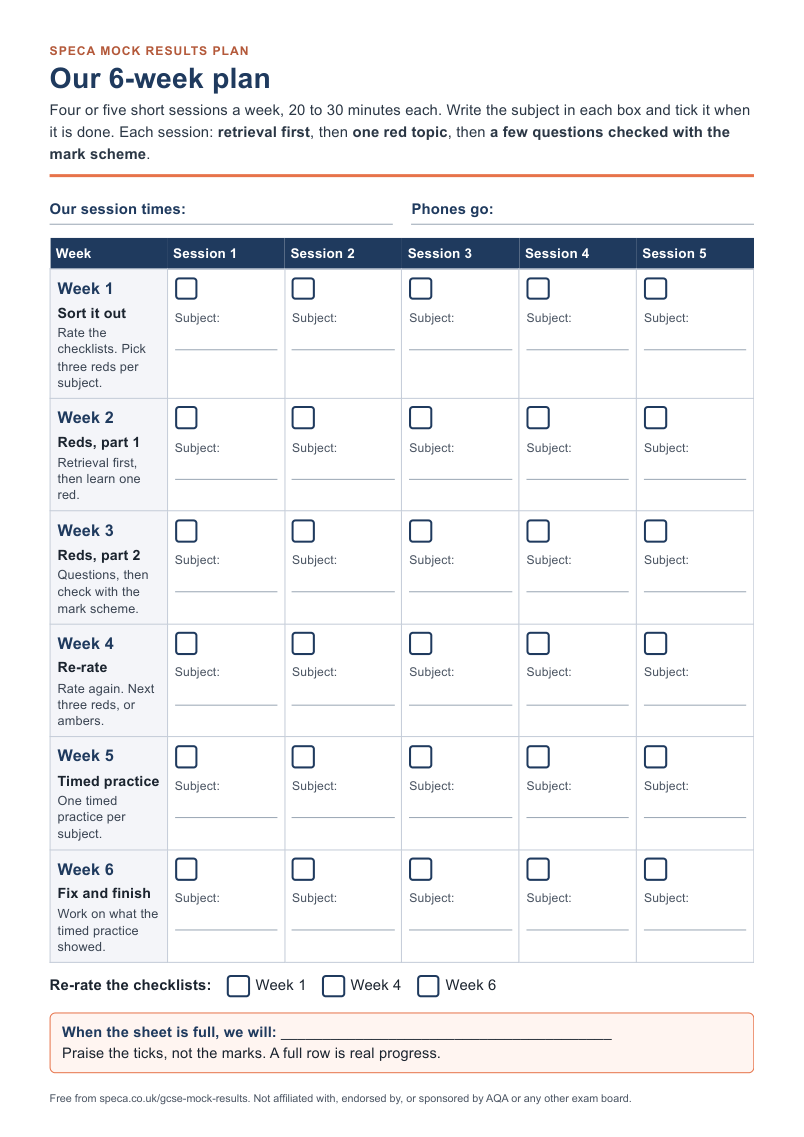
Our 6-week plan
The fridge planner: 30 session boxes to tick, and space for your agreed times.
Download the PDF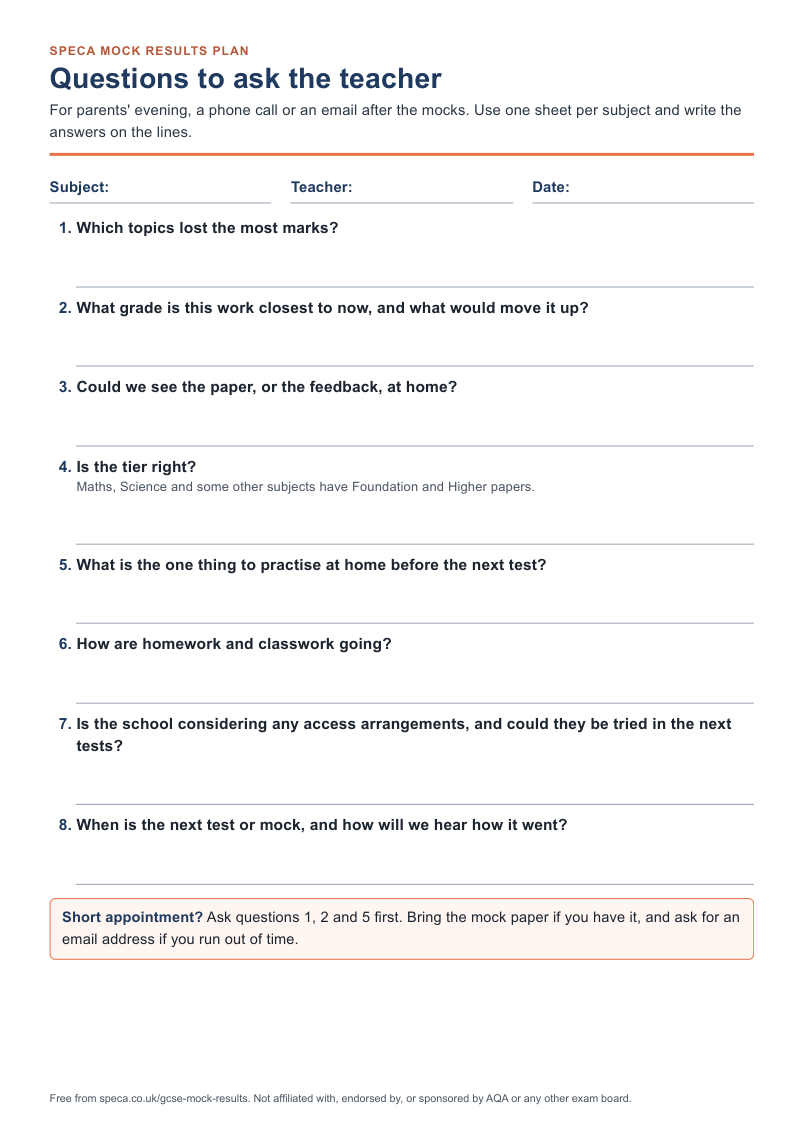
Questions to ask the teacher
Eight questions with space for the answers. One sheet per subject.
Download the PDF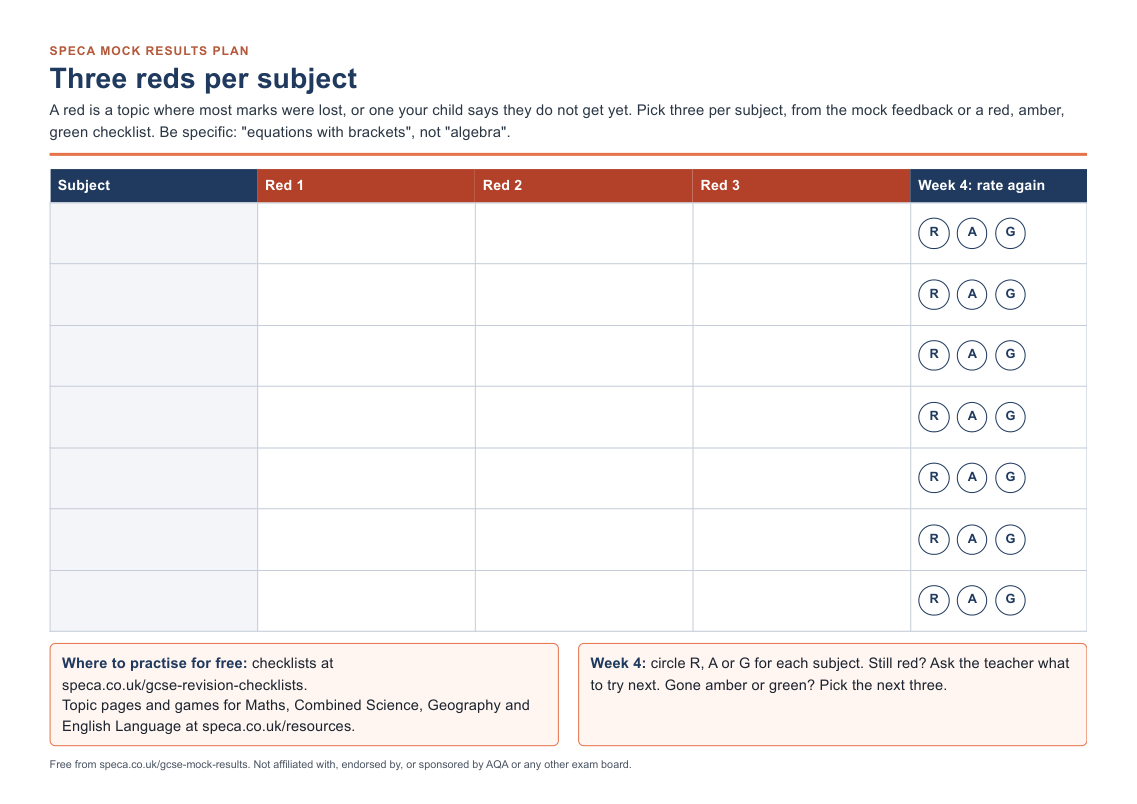
Three reds per subject
Write down the three reds for each subject, and rate them again in week 4.
Download the PDFAlready finished GCSEs and resitting?
If your child is past Year 11 and resitting English Language or Maths, use the November resit plan instead: 2-week and 4-week plans with printable planners.
On a different exam board?
Speca's resources are written to the AQA GCSE specifications. The method on this page works for any board: rate the topics, pick three reds, retrieval first, questions with a mark scheme. But topic lists, papers and question numbers differ between boards, so check your child's board with the school.
A teacher?
Every topic behind this plan has a full lesson bundle: slides, worksheet, mark scheme, homework and assessment, with SEN-friendly lesson design as standard. 3 free bundles a month, no card.
Start freeSpeca is not affiliated with, endorsed by, or sponsored by AQA or any other exam board. The plan and advice on this page are written by Speca in our own words; they are not exam board documents.